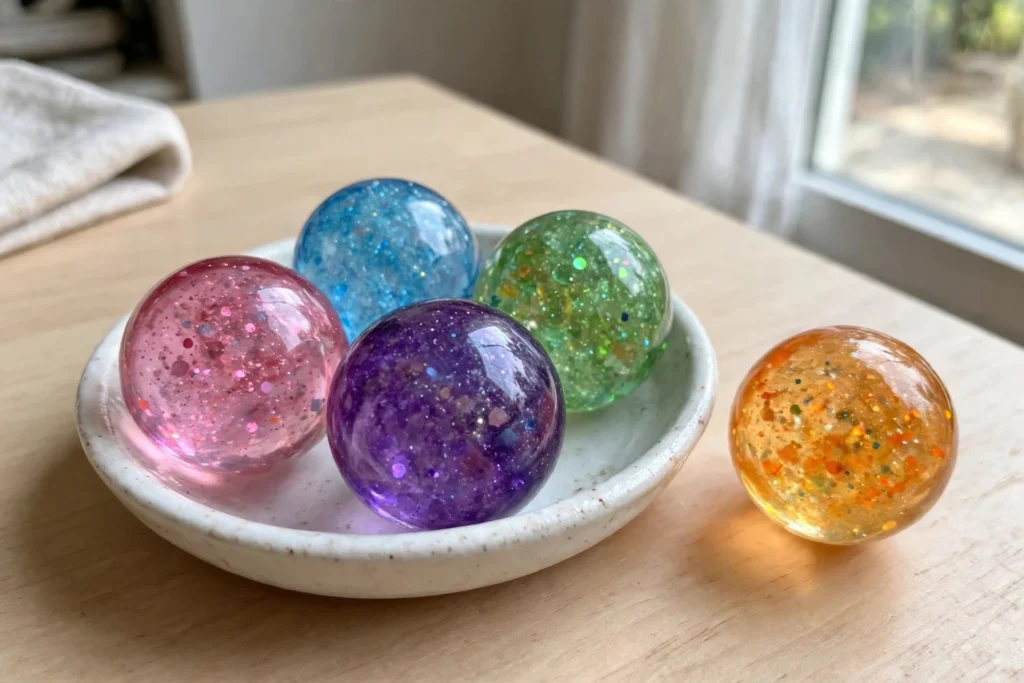
Homemade bouncy balls are one of those projects that sounds too good to be true — glue, cornstarch, a little color, and suddenly you have real bouncing balls. The first time we dropped one and it actually bounced, my kids lost their minds. Then they immediately wanted to make one in every color.
The mixing is the science, the shaping is the sensory fun, and the bouncing is the reward. This one earns its place in the rotation.
Why You'll Love Making This
Kids get to watch a liquid turn into a solid, moldable ball right in their hands — it is a hands-on chemistry lesson that feels like pure play. Measuring and mixing builds patience, and rolling the perfect sphere is genuinely satisfying even for adults.
It is also wonderfully low-cost. A bottle of school glue and a box of cornstarch make a whole collection of bouncy balls, which means this is perfect for playdates, birthday party activities, and classroom projects.
Materials You'll Need
- White school glue — the main ingredient
- Cornstarch — for thickening the mixture
- Water — just a small amount, for consistency
- Food coloring — optional, for colorful balls
- A small mixing bowl — for combining everything
- A spoon or stick — for stirring
- Wax paper or a non-stick surface — for drying the balls
Step-by-Step Directions
- Pour a generous amount of white school glue into your mixing bowl.
- Add a small splash of water and stir gently until the glue becomes a little more fluid.
- Gradually stir in cornstarch, a spoonful at a time, watching the mixture thicken from liquid to a soft paste.
- Add a few drops of food coloring and mix until the color is even throughout.
- Scoop up the mixture and roll it between your hands into a smooth ball, adding a pinch more cornstarch if it is too sticky.
- Place each finished ball on wax paper and let it dry for several hours or overnight.
- Test the bounce — and then make more in every color.
Tips for the Best Bouncy Balls
The ratio is more art than science, so go slowly with the cornstarch — too much makes a crumbly ball that will not bounce. Smooth, crack-free rolling is the secret; take your time shaping each ball and seal any cracks by rolling a little longer. Let them dry fully before the big bounce test, or they will flatten on impact.
Store finished balls in a small bag or container, kept dry. If they lose their spring over time, that is normal — just mix up a fresh batch.
Fun Variations to Try
Stir in fine glitter before shaping for dazzling sparkle balls. Marble two colors together by barely mixing them for a swirled effect. Try different sizes — a big bouncy ball has a wonderfully satisfying bounce. Small silicone molds can shape the mixture into stars and hearts for a fun twist.
FAQs
Can kids make these on their own?
Yes, with supervision. The ingredients are simple, but an adult should oversee the measuring and help younger kids with the rolling.
Why are my bouncy balls not bouncing well?
The balance of glue to cornstarch is probably off. Too soft means add more cornstarch next time; too hard and crumbly means use a little less.
How long do they last?
Stored dry in a container, they keep their bounce for weeks or even months. They will eventually dry out and lose their spring.
Can I use a different kind of glue?
White school glue works best and is the safest choice. Other glues may change the texture or not be kid-safe, so stick with school glue.
Is the mixture safe on skin?
Yes — it is just glue, cornstarch, water, and food coloring. Wash hands afterward, especially if you used food coloring.
Can I add glitter?
Absolutely. Fine glitter mixed in before shaping makes gorgeous sparkle bouncy balls that catch the light.

 Easy Seashell Crystal Geodes for Kids
 DIY Lava Lamp with Alka-Seltzer for Kids
 Easy Crystal Growing Experiment for Kids
 Easy Glowing Rainbow Thundercloud in a Jar for Kids
Leave a Reply